Fitness paradigms often divide physical training into isolated categories. Weightlifting builds strength, cardiovascular exercise enhances endurance, and basic stretching improves flexibility. However, modern movement science highlights the importance of training the body as an integrated system. Functional movement relies not just on raw force or passive muscle length, but on the dynamic combination of strength and mobility working together.
Yoga provides a holistic training methodology that bridges these physical attributes. By combining bodyweight resistance, isometric holds, full range of motion exercises, and controlled breathwork, yoga develops functional strength alongside dynamic mobility. Practicing yoga regularly enhances movement quality, builds resilient joints, and creates balanced physical fitness.
Redefining Strength and Mobility in Human Movement
To understand the unique physical benefits of yoga, it is helpful to clarify what strength and mobility mean in a functional context. While often confused with flexibility, mobility represents a distinct physical capacity that directly influences athletic performance and daily movement.
-
Flexibility versus Mobility: Flexibility refers to the passive length of a muscle—how far a muscle can stretch when an outside force acts upon it. Mobility, on the other hand, is the active ability of a joint to move through its full intended range of motion under conscious control. Mobility requires both flexibility and functional strength at the end ranges of motion.
-
Isotonic versus Isometric Strength: Conventional resistance training often focuses on isotonic contractions, where muscles shorten and lengthen against external weights. Yoga relies heavily on isometric contractions, where muscle fibers generate force without changing length to hold static positions. Isometric training builds deep muscular endurance and stabilizes joint structures.
-
Relative Bodyweight Strength: Rather than moving external objects, yoga emphasizes relative strength—the ability to control and manipulate your own body mass through space. Developing relative strength improves spatial awareness, balance, and core coordination.
How Yoga Builds Functional Muscular Strength
Building muscular strength through yoga relies on leveraging body weight against gravity in varied geometric orientations. Poses that appear static actually require complex, multi-directional muscular activation.
Time Under Tension and Muscular Endurance
Holding static poses such as Warrior II, Chair Pose, or High Lunge creates sustained time under tension for major muscle groups. In Chair Pose, the quadriceps, glutes, and core stabilizers engage continuously to maintain a deep knee bend against gravity. This sustained effort forces muscle fibers to adapt, increasing both slow-twitch fiber recruitment and localized muscular endurance without placing heavy compressive loads on the spine.
Progressive Loading Through Gravitational Angles
Yoga alters physical leverage to increase resistance without using dumbbells or barbells. For example, moving from a standard knees-down push-up to a high Plank Pose increases the weight borne by the upper body. Progressing to Chaturanga Dandasana or an arm balance like Crow Pose shifts progressively higher percentages of total body weight onto the shoulders, triceps, chest, and wrist stabilizers, stimulating muscular growth and tendon adaptation.
Target-Specific Stabilizers and Deep Core Networks
Traditional weight training machines often isolate large global muscles like the chest or quadriceps while minimizing the work of smaller stabilizing muscles. Yoga postures require whole-body stabilization. Balances such as Half Moon Pose or Tree Pose fire the deep gluteal medius, ankle stabilizers, and transverse abdominis to prevent falls. Strengthening these secondary stabilizers creates a protective shield around major joints and prevents overuse injuries in larger muscle groups.
The Science of Improving Mobility Through Yoga
Gaining mobility requires teaching the nervous system that a joint is safe and strong throughout its full range of motion. Yoga uses several physiological mechanisms to unlock joint movement and improve mobility safely.
Active End-Range Strengthening
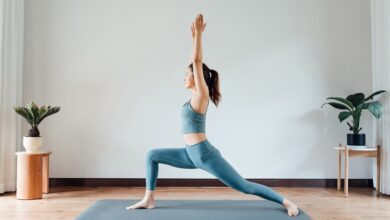
Passive stretching can temporarily lengthen muscle tissue, but without strength at those extended lengths, the nervous system often contracts the muscle again to prevent injury. Yoga poses demand active muscle engagement at the furthest boundaries of a joint range. For instance, in a deep Low Lunge, the rear hip flexors are actively stretched while the glutes and core engage to stabilize the pelvis. This active control signals safety to the central nervous system, creating lasting gains in usable joint mobility.
Dynamic Loaded Movement Patterns
Flow styles of yoga, such as Vinyasa or Ashtanga, move the body through dynamic transitions. Moving fluidly from Downward-Facing Dog into a Lunge and then rising up to Warrior I takes the ankles, knees, hips, and shoulders through continuous, controlled arcs of movement. This continuous motion lubricates joint capsules with synovial fluid, reduces stiffness, and hydrates myofascial tissue throughout the body.
Neuromuscular Re-education and Reciprocal Inhibition
Yoga utilizes natural physiological reflexes to expand movement ranges. One key mechanism is reciprocal inhibition: when one muscle contracts, the brain automatically sends a signal to relax the opposing muscle. In a Seated Forward Fold, actively contracting the quadriceps signals the brain to release tension in the hamstrings, allowing a deeper, safer hinge at the hips without forcing the tissue.
Complementing Other Forms of Athletic Training
For runners, weightlifters, cyclists, and team sport athletes, cross-training with yoga offers distinct performance advantages that traditional workouts cannot replicate.
-
Injury Prevention and Tissue Resilience: Repetitive movement patterns in sports like running or cycling can create tight, overused muscles alongside underactive stabilizing muscles. Yoga balances these kinetic chains by strengthening neglected stabilizers and lengthening tight muscle groups, reducing the risk of strain injuries.
-
Faster Athletic Recovery: Gentle, mobility-focused yoga promotes active recovery. Light movement increases blood circulation to tired muscle tissues, flushing out metabolic waste products and supplying fresh oxygen and nutrients without inducing additional tissue trauma.
-
Enhanced Agility and Balance: By challenging proprioception through asymmetrical balancing poses, yoga sharpens motor control. Improved body control allows athletes to change direction, absorb force, and react quickly in competitive environments.
Structuring a Practice for Maximum Strength and Mobility Gains
To maximize the physical adaptations of yoga, practitioners should align their approach with their specific fitness goals. Different styles and pose selections yield distinct physical outcomes.
To build functional strength, emphasize holding strong standing poses, arm balances, and core-intensive sequences for five to ten breaths. Styles such as Power Yoga, Ashtanga, or Forrest Yoga provide higher physical demands that stimulate muscle development.
To focus primarily on joint mobility and tissue release, incorporate longer-held stretches and fluid movement patterns. Styles like Hatha Yoga or slow Vinyasa flows allow time to explore joint ranges, while Yin Yoga targets deep connective tissues and fascia through passive holds supported by the breath. Combining dynamic strengthening sessions with slow mobility practices creates a well-rounded routine that supports long-term physical durability.
Frequently Asked Questions
Can yoga replace traditional weightlifting for building muscular strength?
Yoga builds impressive relative strength, body control, and muscular endurance using body weight as resistance. However, it operates primarily through isometric holds and relative body mass. Weightlifting allows for progressive overload beyond your body weight, which is more effective for maximizing raw muscle hypertrophy and maximal power output. Combining both disciplines often yields optimal physical performance.
How many times a week should I practice yoga to see noticeable gains in mobility?
Consistent practice two to three times per week for thirty to sixty minutes yields noticeable improvements in mobility within four to six weeks. Short, ten-minute daily mobility sessions targeting specific tight joints, such as the hips or shoulders, can accelerate these results even further.
Is dynamic flow yoga or holding static poses better for improving joint mobility?
A combination of both offers the best outcomes. Dynamic flow movement lubricates joint structures with synovial fluid and prepares tissues for movement, while holding active poses builds control and strength at the end ranges of motion, locking in long-term mobility gains.
Why do my muscles shake during static yoga holds like Chair Pose or Plank?
Muscle shaking is a normal neurological response during static holds. It indicates motor unit fatigue within the target muscles. As primary muscle fibers tire, your nervous system rapidly recruits additional motor units to maintain the position, causing temporary, harmless muscular tremors as those fibers fire asynchronously.
Can individuals with hypermobility safely practice yoga?
People with hypermobile joints can safely practice yoga, but they must focus on building stability rather than pushing for deeper stretches. Hypermobile practitioners should avoid dumping into overextended joint ranges and instead concentrate on actively contracting the surrounding muscles to support and protect the joints during every pose.
How does breath control influence mobility performance during a yoga class?
Controlled diaphragmatic breathing calms the parasympathetic nervous system, lowering muscle tone and reducing the body stretch reflex. When the nervous system senses a calm state through slow, deep exhalations, it allows muscles to release chronic guarding patterns, making it easier to access deeper joint ranges safely.
Should I practice yoga before or after a heavy strength training workout?
For optimal performance, practice short, dynamic mobility yoga sequences as a warm-up before lifting to increase range of motion and joint lubrication. Reserve longer, restorative, or intense strengthening yoga practices for after your workout or on off days to avoid fatiguing muscles prior to lifting heavy weights.